
contact@wix.com
+123-456-789
© 2035 by The Clinic.Powered and secured by Wix
Sardinia by ox-drawn cart
The Day We Stepped Out of Our Cars
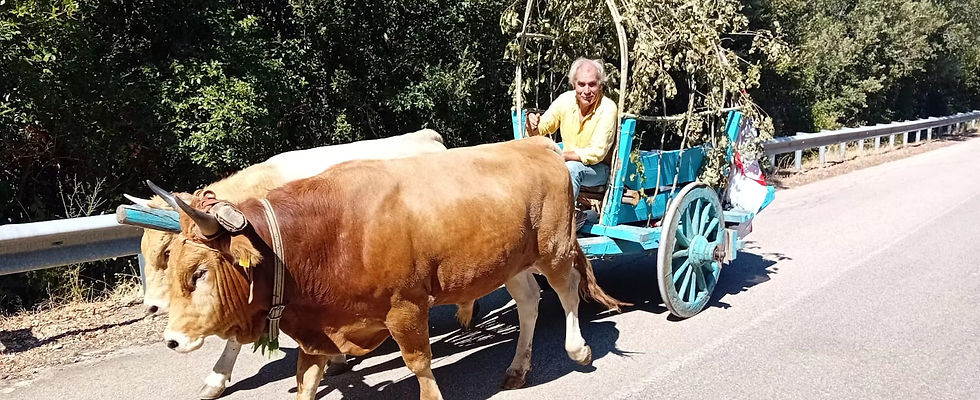
Today, the journey of “The Island… by Ox-Drawn Cart” began. Setting off from Porto Pozzo, in northern Sardinia, does not simply mark the beginning of a route across the island. Above all, it affirms a principle that may appear simple, yet today feels almost subversive: we need to rediscover slowness.
I want to be clear. I am not talking about slowness as an inability to act, as laziness, backwardness, or nostalgia for an idealised past. I mean slowness as a regulating principle of human life.
The value of this journey does not lie primarily in the folkloric revival of a means of transport belonging to another age. If that were all, it would be enough to watch the cart pass by, photograph it, remember how our grandparents once lived, and then return to our cars.
No. The ox cart becomes meaningful when it ceases to be an object from the past and begins to question the present. Because travelling by cart means accepting something we have almost entirely forgotten: every action has a time that belongs to it.
There is a time it takes to cross a landscape, to arrive somewhere, to get to know someone, to work, to rest and, ultimately, to live. And yet, in our distracted and overly ambitious way of living, we have tried to erase this principle.
We have built cars, aeroplanes, high-speed trains, instant connections, devices capable of compressing space and time. These tools have undoubtedly expanded human possibilities enormously. But in doing so, we have gradually confused the speed of our technologies with the speed at which our lives ought to unfold.
This is where one of the great contradictions of modernity begins.
We believe we have become faster because the machines we use have become faster. In reality, we have ended up asking our bodies, our attention and our emotions to adapt to the rhythm of machines. It is difficult, in this regard, not to think of Charlie Chaplin’s Modern Times: the human being desperately trying to synchronise his body with the production line, until he himself becomes one of its gears.
Perhaps the contemporary problem, then, is not simply that “we do too many things.” The deeper issue is that we have internalised a speed that does not belong to our bodies.
Stress — a condition we still struggle to recognise fully as an illness — can also be understood from this perspective: as the response of an organism continuously forced to pursue a rhythm it can no longer metabolise. Not merely an individual problem to be managed through relaxation techniques, but the symptom of a possible incoherence between biological time and social time.
Progress constantly promises to save us time, and yet we have become a society that never seems to have enough of it. That may be its most radical paradox.
Today, during the first day of the journey, something extraordinarily simple happened: we stepped out of our cars and, in doing so, had to give up our speed for a few hours.
The cart cannot be accelerated at will. It does not respond to a pedal. It does not instantly obey human intention… because there are animals in front of it. And this is where, for me, the journey takes on an even more interesting anthropological meaning. The cart moves at the pace of the oxen.
We may wish to arrive sooner. We may have a programme, a timetable, a destination. But the journey moves forward only to the extent that the animals are able — and willing — to move.
Suddenly, the human being is no longer the sole regulator of time. We are “forced” to observe, wait, listen and adapt. And perhaps we should even be grateful. Because, in this case, it is precisely the animals who return to us something we had forgotten: a sense of measure.
The ox knows nothing of our haste. It knows nothing of notifications, meetings, deadlines or the artificial accelerations with which we have surrounded our days. Its pace still belongs to the body, to the ground, to temperature, fatigue and distance. And for a few kilometres, at least, we were “forced” to enter that time. But there is an even more important point, one that cannot be avoided: in this anthropological scenario, the animals are at the helm. Not only because they determine the pace of the journey. Not only because the cart advances at their rhythm, because they need to stop, drink, rest and be listened to. But because everything that happens here is built with the animal, not upon the animal.
This distinction is fundamental.
Within the industrial model, the animal is often conceived as a body to be managed, accelerated, contained and made efficient. Here, the opposite occurs: the journey can exist only if the relationship works. The ox is not the passive support of the experience. It is one of its protagonists. Today I saw this very clearly.
At one point, the animals stopped and rested. I watched them closely as, completely at ease, they even closed one eye, as living beings do when they sense that their surroundings require no state of alert. No one pushed them to begin again. No one tried to bend their time to fit our schedule. The journey simply stopped because they had stopped. And contained within that simple fact is an enormous lesson. It means accepting that another living being possesses its own rhythm, its own threshold of fatigue, its own right to pause. It means also entering into a relationship in which the human being no longer claims to be the sole centre regulating action.
From an anthropological perspective, we could speak of a genuine interspecies alliance between two subjects inhabiting space and time together. Not in the romantic sense of a relationship devoid of interests or asymmetries. Humans do, of course, receive something from the animal: labour, strength, mobility, and the continuity of a cultural practice. But the animal also receives something from humans: care, protection, food, attention, a stable relationship, a shared form of life. This is where interdependence emerges.
It is not only the human who needs the animal. The animal, too, lives within a human world that contributes to feeding it, protecting it and giving orientation to its existence.
The relationship is not without interests, but this does not automatically make it violent. On the contrary, it can become a form of reciprocity built over time. For this reason, I believe it is important not to avoid the objections of those who, quite legitimately, look with suspicion at any form of relationship between humans and working animals. The problem of intensive farming, cruelty and the reduction of animals to commodities remains entirely real and must not be minimised. But precisely for this reason, we need to make distinctions.
Not every relationship with animals is equivalent to industrial exploitation. Not every form of shared labour erases the animal’s otherness. There are contexts in which the animal remains visible as a subject, in which the relationship is regulated through care, and in which the animal’s limit becomes the human being’s limit as well. Here, the ox is not forced into human time. It is the human who must learn to enter the animal’s time. And perhaps this is the most radical point of all.
For several hours today, we were not entirely the ones deciding how to move, when to move, or how far to move. We had to observe. We had to wait. We had to adapt. We had to allow ourselves to be educated by the animal.
Perhaps it is precisely at this point that the experience definitively ceases to be folklore. The ox cart is not a relic: it is a living laboratory of relationship. It shows us that another form of coexistence is still possible: one in which the non-human is not merely a tool, but a partner; not a background, but a presence; not an object, but a subject within the relationship. And it reminds us that caring for an animal is not an incidental gesture. It is a form of responsibility.
I am certain that animals perceive the quality of this presence. They sense rhythm, calm, the absence of coercion, familiarity. And within that relationship something emerges that belongs neither exclusively to the human nor exclusively to the animal. A shared world is created.
“The Island… by Ox-Drawn Cart” begins here: with the possibility, for a while, of stepping outside the machine we have built around our lives and listening once again to the rhythm of the body, the earth and other living beings.
Today we stepped out of our cars.
We began to move at the pace of the oxen… because the journey exists only because we make it together.